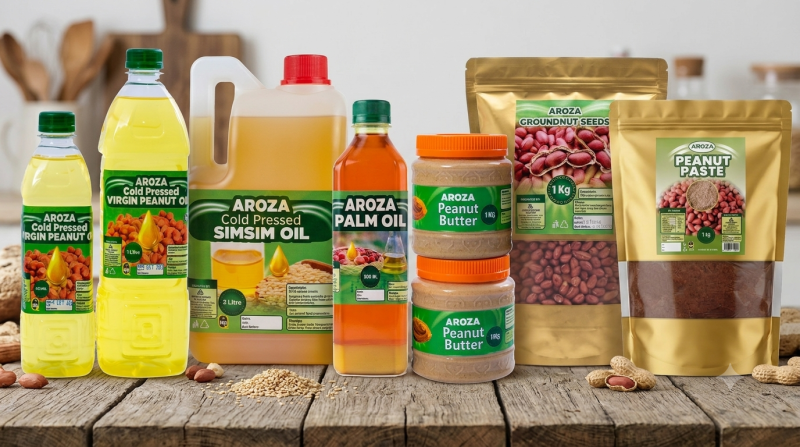
For Aroza Group Limited, growth started with something many small businesses know well: customers telling other customers about the products they love.
For years, word-of-mouth and walk-in customers helped the Ugandan natural foods business build its customer base. People discovered Aroza, bought its products, and came back. But as the business grew, a new challenge emerged.
How do you turn natural, organic growth into sustainable business growth?
That question became increasingly important for Aroza as it sought to strengthen its market position and reach more customers.
Aroza produces natural food products with a focus on providing safer alternatives to poorly processed foods, particularly groundnut products. Its products also have potential beyond household consumption, including applications in the beauty and wellness sector, as well as opportunities with commercial and export buyers.
The products had potential. The customers were there. What was needed was a clearer strategy for connecting the two.
A business with customers—but room to grow
Before receiving technical assistance, Aroza's customer growth was largely driven by walk-ins and referrals. While this showed that customers were interested in the products, the business did not yet have a structured customer relationship management system or a consistent approach to customer retention.
A closer look at its customer base revealed an important opportunity.
Around 90% of Aroza's customers were low-volume retailers, while only 10% were customers spending UGX 100,000 or more per purchase.
The finding changed the way the business could think about growth.
Instead of simply asking how to attract more customers, Aroza could begin asking a more strategic question:
How can we turn the customers we already have into loyal, repeat customers—and attract more customers who see greater value in what we offer?
The market assessment showed that while competitors had established market presence and strong partnerships, there was an opportunity to differentiate through clearer, more consistent and customer-focused messaging.
Aroza needed more than a marketing campaign - It needed a stronger identity.
Finding a message that could bring everything together
Through the Finding XY Technical Assistance Facility (TAF), Aroza participated in a 14-working-day Marketing, Sales and Distribution Strategy engagement between June and July 2026.
The support focused on more than theory. Finding XY worked with the Aroza team to examine its customers, market position, sales approach and brand, and then translate those insights into practical tools and systems the business could continue using.
One of the most significant outcomes was a new brand position built around one simple but powerful word “NOURISH” from this came Aroza's brand promise:
“Nourishing People, Empowering Farmers.”
The idea was then built around three pillars: “Nourishing Your Family, Nourishing Your Body, and Nourishing Your Business”
This gave Aroza a clearer way to tell its story and communicate the value of its products.
For families, the focus is on natural, additive-free products that can support everyday cooking and family wellbeing. For beauty and wellness businesses, products such as cold-pressed sesame oil present opportunities in spas, salons and skincare. For commercial and export buyers, Aroza can position itself around reliable supply and quality products.
One brand could now speak to several markets—without losing the purpose at its centre.
From selling products to building relationships
But branding was only part of the transformation.
Aroza also needed to rethink what customer growth meant.
The team adopted an ambitious idea: 1,000 loyal customers could be more valuable than 100 new walk-ins every day who never return.
That thinking shifted the focus from one-time transactions to relationships.
With support from Finding XY, Aroza developed a three-tier loyalty programme:
- Bronze for new customers;
- Silver for returning customers; and
- Gold for high-value customers, with enhanced rewards and exclusive benefits.
The programme is complemented by practical customer-retention ideas such as birthday bonuses, referral rewards, punch-card incentives, happy-hour promotions, 30-day purchase challenges and surprise gifts.
These may seem like small changes, but together they represent a major shift in how a growing business thinks about its customers.
Aroza is no longer only asking, “Did someone buy from us?”
It is beginning to ask:
Who are our customers? What do they need? How often do they buy? What makes them return? And how can we build a relationship that keeps them connected to the brand?
Putting customer information to work
One of the most practical changes was the introduction of a structured customer database.
Aroza developed a five-sheet system covering:
Leads → Customers → Sales Pipeline → Activities → Dashboard.
This gives the business a centralised way to capture customer information, monitor sales opportunities and track interactions.
For a business that previously had no CRM system, this is an important step.
Customer information can now become more than a list of names and phone numbers. It can help Aroza understand which customers are returning, where leads are coming from, which customers have higher purchasing potential and where follow-up is needed.
The strategy also helped the team recognise that not all customers are the same.
A retailer buying Aroza products for resale has different needs from a household buying for personal consumption. A spa purchasing sesame oil has different priorities from a supermarket or hospitality business.
Aroza therefore developed a customer segmentation approach based on factors including end use, business profile, purchase drivers, customer value and location.
This creates an opportunity for the business to communicate more intentionally with different audiences rather than treating every customer in exactly the same way.
Turning strategy into action
The engagement also produced a range of practical tools to help Aroza move from planning to implementation.
These included a brand strategy and messaging blueprint, customer positioning and segmentation framework, customer onboarding and retention system, loyalty programme, marketing and messaging strategy, and a proposed social media campaign.
A proposed campaign, “Tubeere Bagimu Mu New Economy,” was developed to bring the brand to life through storytelling, educational content, testimonials, product demonstrations, loyalty incentives and digital engagement across platforms such as TikTok, YouTube, Instagram and WhatsApp.
The aim is not simply to tell people that Aroza's products are natural.
It is to help customers understand why that matters to them.
A team ready to take ownership
Perhaps one of the most important parts of Aroza's journey is that the transformation was not designed to depend permanently on external support.
By the final review in July 2026, the Aroza team had already begun revising its catalogue and website to reflect the new brand position. The customer registration process was underway, the customer database had been finalised, and the loyalty programme and packaging rebrand concept were ready for implementation.
The team also reported a stronger understanding of the direction the business needed to take and rated its confidence to implement the changes at 7 out of 10 independently.
Another encouraging discovery was that customers were more willing to share their contact information than the team had initially expected. This creates new opportunities for Aroza to stay connected with customers through personalised follow-ups, WhatsApp communication and loyalty initiatives.
The team also valued the practical nature of the engagement, particularly the use of real examples and an independent external perspective that helped translate ideas into actions.
What success looks like next
Aroza's story is still being written.
The engagement did not immediately produce claims of increased revenue or customer numbers—and importantly, the business is not presenting them as achieved results yet. Some elements, including the social media campaign, loyalty programme and packaging rebrand, were still awaiting full implementation at the time of the final review.
Instead, Aroza now has something it did not have before: a structured foundation for measuring and driving future growth.
The business plans to track indicators including repeat purchase rates, customer retention, revenue and profit growth, referrals, average order value, loyalty programme participation and WhatsApp engagement.
These measures will help Aroza understand whether its new approach is translating into stronger customer relationships and commercial performance.
A new chapter for Aroza
Aroza began this journey with a strong product and a customer base built largely through trust and word-of-mouth.
It is now building the systems to take that trust further.
With a clearer brand identity, defined customer segments, a loyalty programme, a structured customer database and a more deliberate marketing strategy, Aroza is moving from organic growth to intentional growth.
The journey is not about abandoning what worked.
It is about building on it.
Word-of-mouth brought Aroza its first customers. Now, the business is working to turn those customers into a community of loyal advocates—and to use stronger systems, clearer messaging and better customer understanding to reach the next stage of its growth.
For Finding XY, Aroza's story demonstrates the value of practical business advisory support: sometimes, a growing enterprise does not need to start over. It needs the right tools, strategy and support to recognise the opportunities already within its business and build a stronger path forward.
And for Aroza, the future is becoming clearer.
Nourishing People. Empowering Farmers. Building a brand ready for sustainable growth.

