

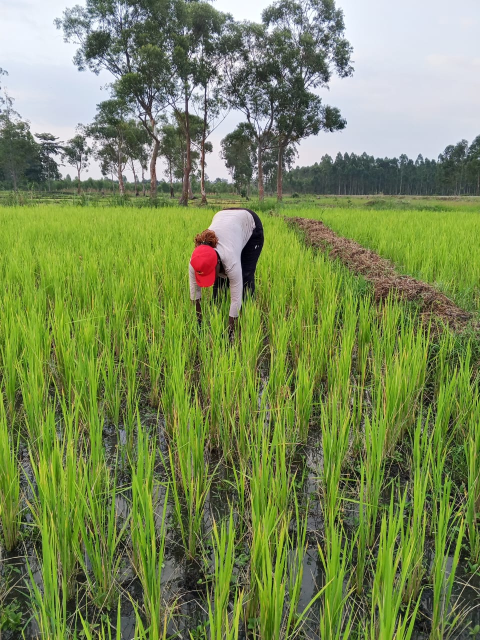
For years, Proscovia Nanduala, the founder of Eloi Mixed Farm, relied largely on her own resources to finance and grow the business. Like many entrepreneurs building their enterprises from the ground up, she focused on keeping the business running, serving customers, and managing the different income streams generated by the farm.
Eloi Mixed Farm is a diversified enterprise with activities spanning agriculture and rice processing. While the business had multiple sources of income and demonstrated potential for growth, Prossy had not yet fully appreciated the commercial opportunities hidden within its day-to-day operations.
One example was the broken rice produced through the processing operation. The broken rice was being sold to other businesses at a relatively low price. Those businesses would then process it into rice porridge and sell the final product at a considerably higher value.
The opportunity was there, but Prossy had not yet looked at the business through the lens of value addition and commercial potential.
That began to change when Eloi Mixed Farm received Technical Assistance focused on strengthening its business and investment readiness. With support for pitch deck development and financial modelling, Prossy was encouraged to look beyond the enterprise's immediate activities and understand what the business data could reveal about its performance and future growth.
The turning point came during a financial modelling session. When the consultant looked through Eloi Mixed Farm’s historical financial records and presented the information visually on a graph, Prossy immediately noticed something she had never clearly seen before.
Each year, the business consistently recorded higher sales in specific months. Prossy already knew that these were stronger months for the business. However, seeing several years of financial information presented together made the pattern much more visible. The numbers revealed a recurring trend.
The periods of increased sales often coincided with rice scarcity and higher market prices. What had previously appeared to be normal fluctuations in the business suddenly became a predictable market opportunity. For Prossy, this was more than a financial exercise; it was a turning point.
“I realised that the business did not have to simply react to shortages and price increases when they happened. With better planning, Eloi Mixed Farm could position itself ahead of the market,” Prossy realized.
Going forward, she plans to stock rice ahead of the peak season, allowing the business to prepare for increased demand, maintain a reliable supply and take advantage of favourable market prices while protecting its margins.
A simple graph had changed the way she viewed her business.
From Records to Decision-Making
The experience also transformed Prossy’s understanding of financial documentation.
Previously, financial records were largely something the business maintained as part of its operations. Through the financial modelling process, she began to see that these records could provide much more value.
The numbers were no longer just records—they were telling her a story about her business. They could show when sales increased, highlight recurring trends, identify opportunities and support decisions about when and how to invest in the business. This new perspective is helping Prossy move from making decisions based primarily on experience and observation to making more deliberate, data-informed business decisions.
The support has also strengthened her understanding of the financial requirements of the business. Through the development of a pitch deck and financial projections, she now has greater clarity on how much funding Eloi Mixed Farm needs and what the business intends to achieve with additional investment.
She has also gained greater confidence in presenting and defending her financial projections when engaging potential investors and other stakeholders.
Seeing the Bigger Potential
For Prossy, the Technical Assistance has therefore been about more than preparing an investment document. It has helped her look at Eloi Mixed Farm differently. The business she once viewed primarily as an enterprise that needed to be financed and managed has increasingly become a business with identifiable growth opportunities, measurable trends and a clearer investment case.
The experience has also encouraged her to think more intentionally about how the different parts of the business can contribute to growth. From identifying opportunities for value addition to planning inventory around predictable market cycles, Prossy is beginning to approach growth with greater structure and confidence.
The broken rice opportunity is one example of this changing mindset. Rather than viewing it simply as a by-product to be sold, Prossy can now see the potential to explore how value addition could create greater returns for the business.
Similarly, the recurring peak-season sales pattern has shown her that historical business performance can provide useful insights for future planning.
Building an Investment-Ready Future
Eloi Mixed Farm is now on a journey from being an enterprise largely financed by its founder to becoming a more data-driven, strategically planned and investment-ready business.
For Prossy, investment readiness is no longer only about having a pitch deck or approaching potential financiers. It is also about understanding the business well enough to explain its performance, demonstrate its potential and make a credible case for why additional capital can support its growth.
The financial modelling process has given her a stronger foundation for doing exactly that.
“Most importantly, it has given us confidence in the potential that already exists within Eloi Mixed Farm. The business does not have to look far to find opportunities. Some of them are already visible in its own records,” said Prossy.
Today, Prossy is learning to use those records to look ahead, to anticipate demand, plan inventory, explore value addition and make more informed investment decisions. For Eloi Mixed Farm, the transformation is therefore not simply about developing a pitch deck.
It is about learning to read the story behind the numbers and using that story to shape the future of the business.